Hotel Minibar Upselling: How to Turn Your Minibar into a Real Revenue Stream
For a long time, the minibar was seen as a thing of the past: high maintenance, hassle at reception, falling revenue. Yet it is one of the few touchpoints where guests can decide to buy right in their room, without any sales conversation. With the right product range, a smart pricing strategy and modern QR code ordering, the minibar becomes a profitable upsell once again – as properties of the NH Collection and Meliá groups have long demonstrated. This guide shows you step by step how to put this into practice in your hotel.
Contents
- Why minibar upselling pays off again
- Choosing the right minibar concept
- Product range: what belongs in the minibar
- Regional & premium products as margin boosters
- Pricing without the rip-off feeling
- QR codes & digital ordering
- In-room presentation & merchandising
- Coffee, tea & snack station as an extra upsell
- Technology: sensor minibar vs. empty fridge
- Billing & inventory management
- Legal matters: price information & hygiene
- Practical guide for hoteliers (checklist)
- Frequently asked questions from hoteliers
- Best practices for more minibar revenue
1. Why minibar upselling pays off again
Many hotels have scrapped the minibar in recent years – and for good reason: the classic set-up with daily restocking, expiry checks and disputed charges at check-out often cost more than it brought in. But the problem was rarely the minibar itself; it was the outdated concept behind it.
Set up correctly, there is a lot to be said for the minibar as a source of revenue:
- Impulse purchases without barriers: guests decide spontaneously in their room – no trip to the bar, no opening hours, no sales conversation
- High margin: drinks and snacks allow mark-ups that would be unthinkable in the restaurant
- Convenience pays: guests knowingly pay for round-the-clock availability right by the bed
- Brand experience: a lovingly curated minibar with regional products enhances the overall experience and your reviews
- Data point: digital ordering tells you what guests really want – valuable for your product range and cross-selling
The minibar is therefore one building block in a broader strategy. For a complete overview of all the levers for increasing revenue per guest, see our guide to the best upsell opportunities for hotels.
2. Choosing the right minibar concept
Before you think about products and prices, decide on a basic concept. In practice, three models have become established:
- Classic stocked minibar: a fridge plus snack area, restocked and billed daily. The highest revenue per room, but also the highest staffing effort
- Empty fridge + ordering: an empty fridge is provided, and products are ordered via QR code or phone and delivered. Less shrinkage, less upkeep – but pure impulse purchases partly fall away
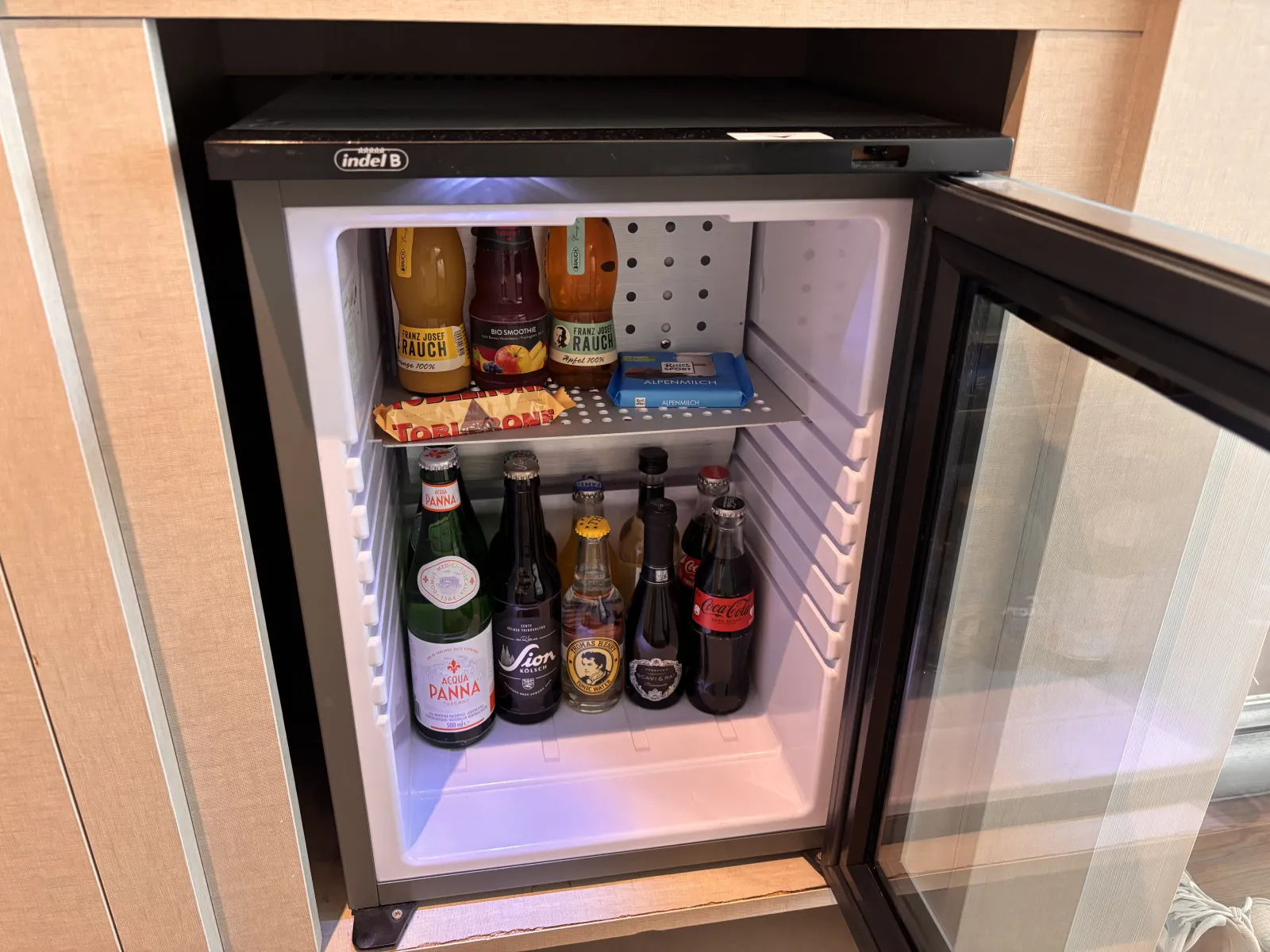
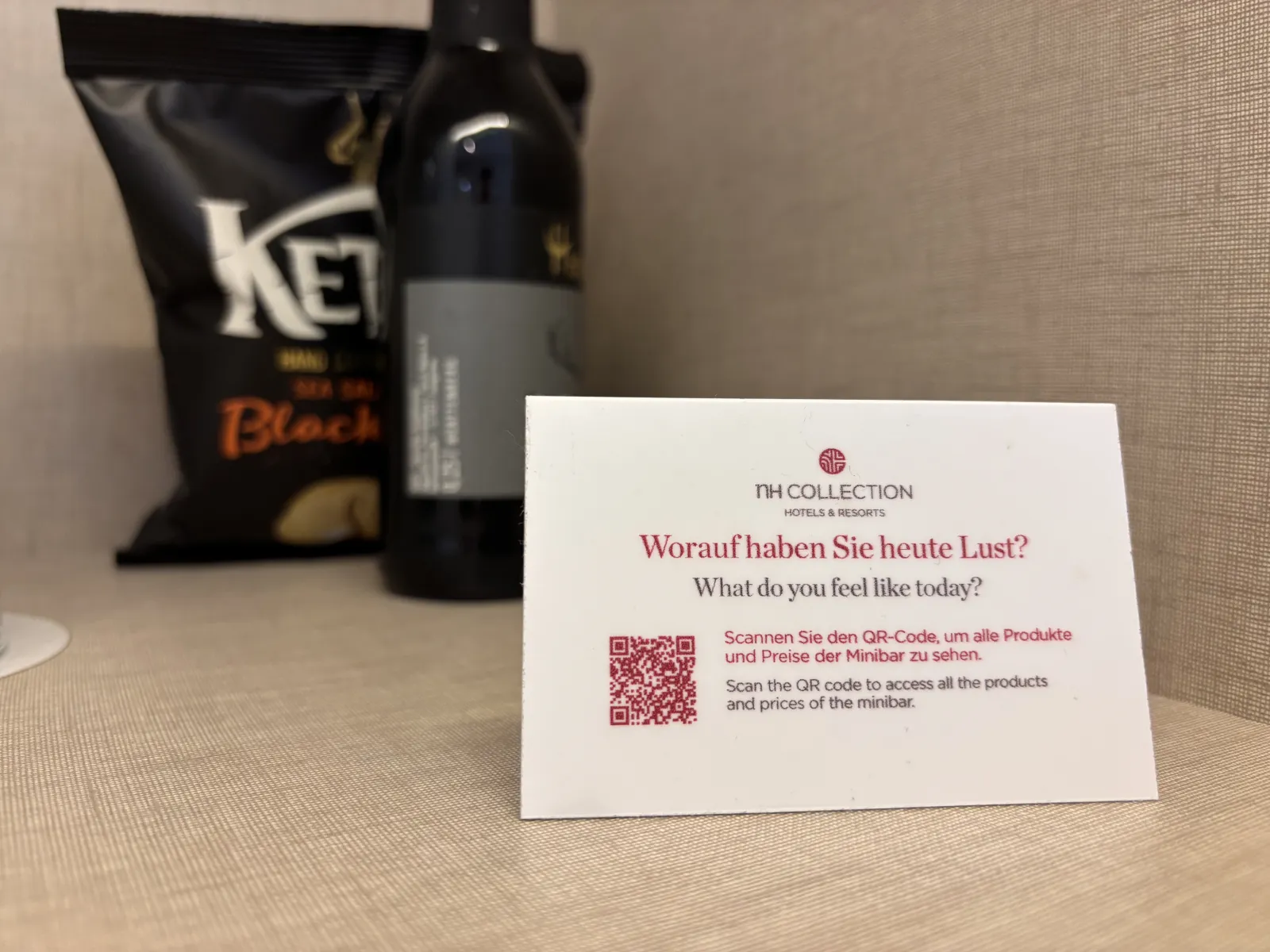
- Hybrid model: a small, high-quality selection is ready in the room (water, a regional speciality, a snack), and everything else can be ordered via QR code. This is now the most popular approach – exactly what the "What would you like today?" card in many NH Collection properties shows
For most three- to five-star properties, the hybrid model offers the best balance of revenue, effort and guest experience.
3. Product range: what belongs in the minibar
The product range determines revenue. Too much choice confuses guests and increases shrinkage; too little leaves money on the table. A curated selection from these categories has proven effective:
- Soft drinks: still & sparkling water, cola, lemonades, juices, smoothies, energy drinks
- Alcoholic drinks: regional beers, a red and a white wine in small bottles, sparkling wine/prosecco, possibly spirit miniatures
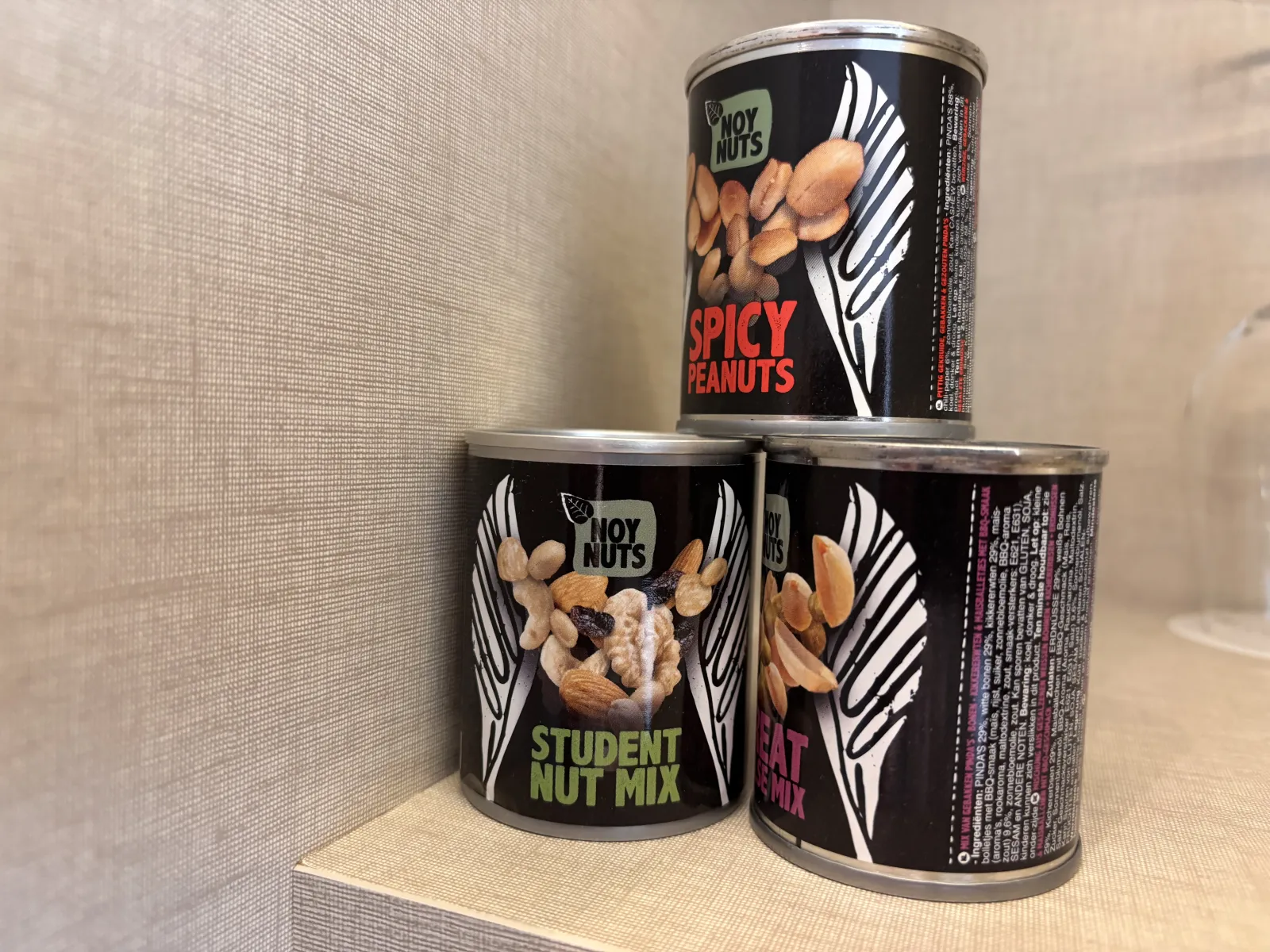
- Savoury snacks: nuts, crisps, trail mix – like the tinned snacks in the picture, which can also be displayed openly
- Sweet snacks: chocolate (e.g. Toblerone), biscuits, regional confectionery
- Extras: condoms, a headache tablet kit, a travel toothbrush – high-margin "emergency" items
Focus on branded products that guests know – this builds trust in the price – combined with one or two special regional products that guests can only find at your hotel.
4. Regional & premium products as margin boosters
The biggest difference between an interchangeable minibar and a profitable one lies in regional and premium products. They are not directly comparable – so guests can't check the price against the supermarket – and at the same time they tell a story about your property and the region.
- Local craft beer or wine: a higher margin and an experience at the same time
- Local chocolate, honey or baked goods: also ideal as souvenirs – guests often buy several at once
- Own-brand snacks: tins or bags with your hotel logo feel exclusive and are hard to compare
- Signature drink: a ready-mixed cocktail or herbal liqueur as the "house speciality"
Products like these can also be showcased brilliantly on your social media channels, strengthening your brand far beyond the individual sale.
5. Pricing without the rip-off feeling
Nothing ruins a minibar faster than guests feeling ripped off – the classic "€6 for a small bottle of water" ends up straight in a Google review. The aim is a noticeable but fair-seeming surcharge for convenience.
- Transparency first: make prices clearly visible – on the card, the QR code menu and the bill. Surprises cause frustration
- Set an anchor: a high-priced signature product makes the other prices seem moderate
- Round, fair prices: water for €3–4, a soft drink for €4–5 and a regional beer for €5–6 are usually accepted; fantasy prices are not
- Offer bundles: a "sundowner set" (wine + snack) or a "movie night box" increases the average spend
- Free anchor: two complimentary bottles of water create goodwill – the rest then sells more easily
Your minibar pricing strategy should fit in with your overall revenue management. We put into perspective what individual extras can realistically bring in in our overview of hotel marketing prices.
6. QR codes & digital ordering
The most important lever for modernisation is ordering via QR code. Instead of a classic price list, there is a card in the room: "What would you like today?" – the guest scans it, sees the complete range with photos and prices and orders in just a few clicks. This is exactly the principle shown by the NH Collection card in the picture.
The benefits for your property:
- No shrinkage, no spoilage: with the hybrid or ordering model, only what has actually been ordered is delivered
- Full transparency: prices and products are digital, clear and up to date – no disputed charges
- A larger range: the digital menu can offer far more than the small fridge can hold – including hot food
- Cross-selling: spa, restaurant or room service can be offered alongside the order
- Measurable: you can see exactly what sells and optimise your range based on data
Digital ordering journeys like these can be elegantly combined with self check-in and an AI concierge, so guests can manage everything through a single digital access point – from arrival to the minibar. Orders can also be taken conveniently via WhatsApp Business.
7. In-room presentation & merchandising
People buy with their eyes – and that applies in a hotel room too. A carelessly crammed minibar sells less well than a curated, attractively presented selection.
- Tidy rather than crammed: fewer products, clearly arranged, with labels facing forward
- Open display: snacks, wine and glasses on a visible tray or shelf – don't hide everything in the cupboard
- High-quality card: a well-designed table card in the look of your hotel brand elevates the whole station
- Lighting: a small spotlight above the snack area draws the eye
- Good photos: in the digital menu, appetising product photos sell significantly better – see our tips for better hotel photos
8. Coffee, tea & snack station as an extra upsell
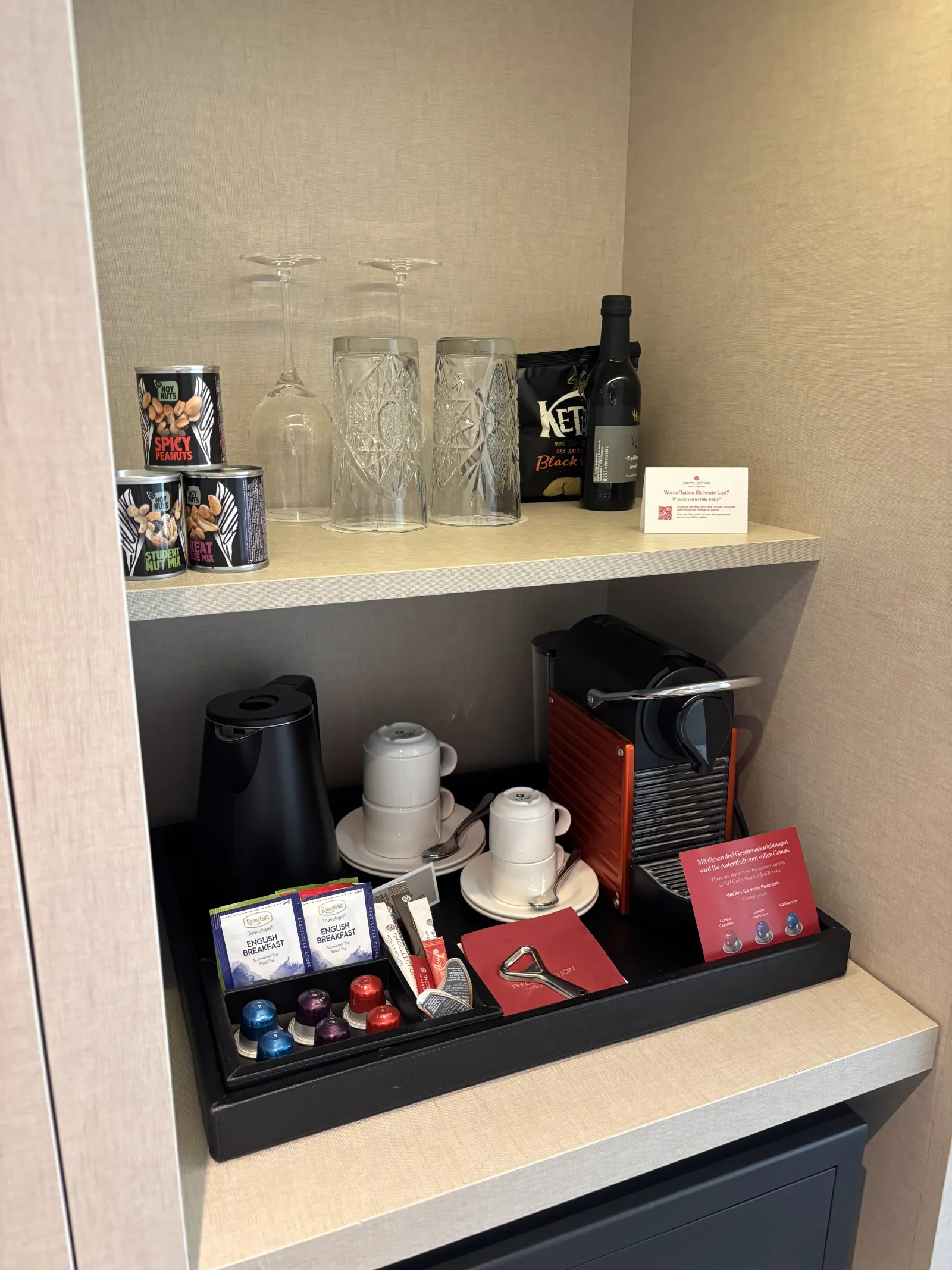
Today, the minibar rarely stands alone: it is part of a small in-room station with a kettle, a coffee machine (often Nespresso) and a selection of teas – just like in the first picture. This station is a twofold upsell lever.
- Free basics, paid upgrade: standard capsules and tea bags free of charge, premium varieties or syrup add-ons for a surcharge
- Sell capsule refills: extra Nespresso capsules or speciality coffee as an orderable item
- Breakfast upsell: "Croissant & fresh coffee to your room", bookable directly via the QR menu
- Place matching snacks: put biscuits or chocolate right next to the coffee station (cross-selling through proximity)
This turns a pure service into another revenue driver – without reception having to step in.
9. Technology: sensor minibar vs. empty fridge
There are two fundamental approaches to the technical side, and they have a major impact on effort and revenue:
- Sensor minibar (automatic): sensors automatically detect when items are removed and charge them to the room bill. The highest convenience and revenue, but expensive to buy and maintain – and occasionally incorrect charges when guests merely lift products
- Manually stocked minibar: consumption is recorded at check-out or during checks. Inexpensive, but labour-intensive and error-prone
- Empty fridge + QR ordering: no sensors, no daily restocking – revenue comes from orders. Minimal effort and the lowest shrinkage, but fewer spontaneous impulse purchases
The trend is clearly towards QR-based ordering, often combined with a small stocked selection. This reduces the drawbacks of expensive sensor technology and labour-intensive manual checks.
10. Billing & inventory management
Whichever model you choose, clean billing determines profitability and guest satisfaction:
- PMS integration: automatically charge consumed or ordered items to the room bill (e.g. Mews, Opera, Apaleo)
- Stock management: monitor minimum stock levels and expiry dates digitally to avoid spoilage and shortages
- Measure shrinkage: regularly check the difference between purchasing, sales and stock
- Control cost of goods: calculate the contribution margin per item and weed out slow sellers
If you keep an eye on purchasing and cost of goods, the minibar becomes a predictable margin rather than a vague sideline. Our guide to hotel expense management provides helpful groundwork.
11. Legal matters: price information & hygiene
When running a minibar in Germany, two areas in particular are relevant:
- Price information: under the German Price Indication Ordinance, all prices must be clear and visible before purchase – whether on the card or in the QR menu. Hidden or surprise prices are not permitted
- Sale of alcohol: observe youth protection rules – with freely accessible alcohol in the minibar, you should consider your target group and, if necessary, locking options (e.g. in family rooms)
- Food hygiene: document the cold chain, best-before dates and cleanliness; check perishable goods regularly
- Allergens: provide allergen information for loose or own-brand products – particularly easy to do digitally in the QR menu
If in doubt, coordinate the concept with your tax adviser (VAT on food/drinks) and, where necessary, with regard to food law.

12. Practical guide for hoteliers (checklist)
So that you can get started right away, here is the step-by-step guide in four phases – from concept to day-to-day operation. Tick off the points in order.
Phase 1 – Concept & product range (1–2 weeks)
- Decide on the model: classic stocked, empty fridge + ordering, or hybrid
- Analyse your target group: business, leisure, families – and align the range accordingly
- Define the core range (drinks, savoury/sweet snacks, extras) plus 1–2 regional highlights
- Contact suppliers for regional/own-brand products
- Calculate the contribution margin per item and derive prices
Phase 2 – Digitalisation & technology (1–3 weeks)
- Set up a QR code menu with photos, prices and an ordering function (in the look of your hotel brand)
- Define the ordering and delivery process (who delivers, and how quickly?)
- Decide between a sensor minibar and QR ordering based on occupancy and budget
- Clarify PMS integration: how does consumption end up on the room bill?
- Test run with several rooms: go through scanning, ordering, delivery and billing
Phase 3 – Presentation & launch (1 week)
- Present the minibar/snack station tidily and on-brand
- Place a high-quality "What would you like today?" table card with a QR code
- Decide on the free anchor (e.g. 2× water) and the signature product
- Train reception & housekeeping on the range, prices and ordering process
Phase 4 – Operation & optimisation (ongoing)
- Analyse sales data weekly: bestsellers, slow sellers, revenue per room
- Adjust the range and prices based on data
- Check stock levels, expiry dates and shrinkage
- Add cross-selling: promote spa, restaurant and breakfast via the QR menu
- Keep an eye on guest feedback and reviews
13. Frequently asked questions from hoteliers
Is a minibar still worth it at all?
Yes – if the concept is modern. The classic, labour-intensive set-up often no longer pays off. A hybrid or QR ordering model with a curated, partly regional range reduces effort and shrinkage and makes the minibar profitable again.
How do I avoid disputes at check-out?
With transparency and digitalisation. Clearly visible prices, automatic charging to the room bill (sensor or QR ordering) and doing away with confusing checks prevent the typical disputes.
QR ordering or a stocked minibar – which is better?
For most properties, a hybrid is ideal: a small, high-quality stocked selection for impulse purchases plus a larger QR menu for everything else. This combines spontaneous purchases with low shrinkage.
How high can prices be?
High enough that the surcharge for convenience still feels fair. Well-known branded products are comparable and should only be moderately more expensive; regional and own-brand products are not comparable and allow higher margins.
Do I need new technology for this?
Not necessarily. A QR code menu connected to your PMS is enough to get started. Sensor minibars are convenient but expensive, and tend to pay off only with high occupancy and an upmarket range.

14. Best practices for more minibar revenue
- Curate rather than cram: a small, clear selection sells better than an overfilled fridge
- Differentiate regionally: non-comparable products create margin and a brand experience
- Price transparently: fair, clearly visible prices prevent bad reviews
- Make it orderable digitally: a QR code menu with photos reduces shrinkage and expands the range
- Set a free anchor: complimentary water creates goodwill and makes the rest more attractive
- Use cross-selling: offer spa, restaurant and breakfast via the minibar menu
- Measure and optimise: push bestsellers, weed out slow sellers, test prices regularly
The minibar is one of the few sources of ancillary revenue where guests buy around the clock without any sales conversation at all. Set up correctly – with a curated range, regional highlights, fair prices and modern QR ordering – an often unloved cost factor becomes a profitable revenue stream. We show you how to embed offers like this into a coherent overall strategy in our guides to hospitality marketing and hotel upselling. Our team will be happy to advise you personally on a tailored concept.